Energy-Flow Cosmology (EFC)
Abstract
Energy-Flow Cosmology (EFC) treats the universe as a thermodynamic information system driven by gradients in energy flow and entropy. Instead of introducing invisible matter or energy components, EFC starts from energy distribution, entropy gradients and information capacity.
The theory is organised into three tightly coupled base layers:
- EFC-S: structural and halo-level descriptions,
- EFC-D: energy-flow dynamics on top of these structures,
- EFC-C₀: base mapping between entropy and information capacity.
This document fixes notation and baseline equations for these three layers, and provides a compact, mathematically explicit core that higher-level models, simulations and epistemic layers can reference without ambiguity. The figures are schematic and illustrate the theoretical structure rather than final data-calibrated fits.
1. Frontmatter
This document is the canonical master specification for Energy-Flow Cosmology (EFC). It defines the formal structure and relations between:
- EFC-S: structural and halo-level descriptions,
- EFC-D: energy-flow dynamics on top of these structures,
- EFC-C₀: base mapping between entropy and information capacity.
The goal is a compact, mathematically explicit core that higher-level models, simulations and epistemic layers can reference without ambiguity.
Version history
- v1.0 Initial formal master specification (structure, fields, schematic figures).
- v1.1 Layout polish, improved spacing, figure placement, and explicit DOI frontmatter.
2. Overview
EFC treats the universe as a thermodynamic information system driven by gradients in energy flow and entropy. Instead of adding invisible components, the model starts from:
- energy distribution,
- entropy gradients,
- information capacity.
The three base layers are:
- EFC-S defines how low-entropy matter distributions organise into halo-like structures,
- EFC-D defines how local energy-flow potentials and their gradients shape dynamics,
- EFC-C₀ defines how entropy and structure map to information capacity and cognitive potential.
A central object is the local energy-flow potential:
which couples density and entropy into a single field.
3. Illustrative Field and Profiles
This section collects schematic figures that visualise the basic EFC fields and profiles. They are theoretical examples consistent with the definitions in the later sections.
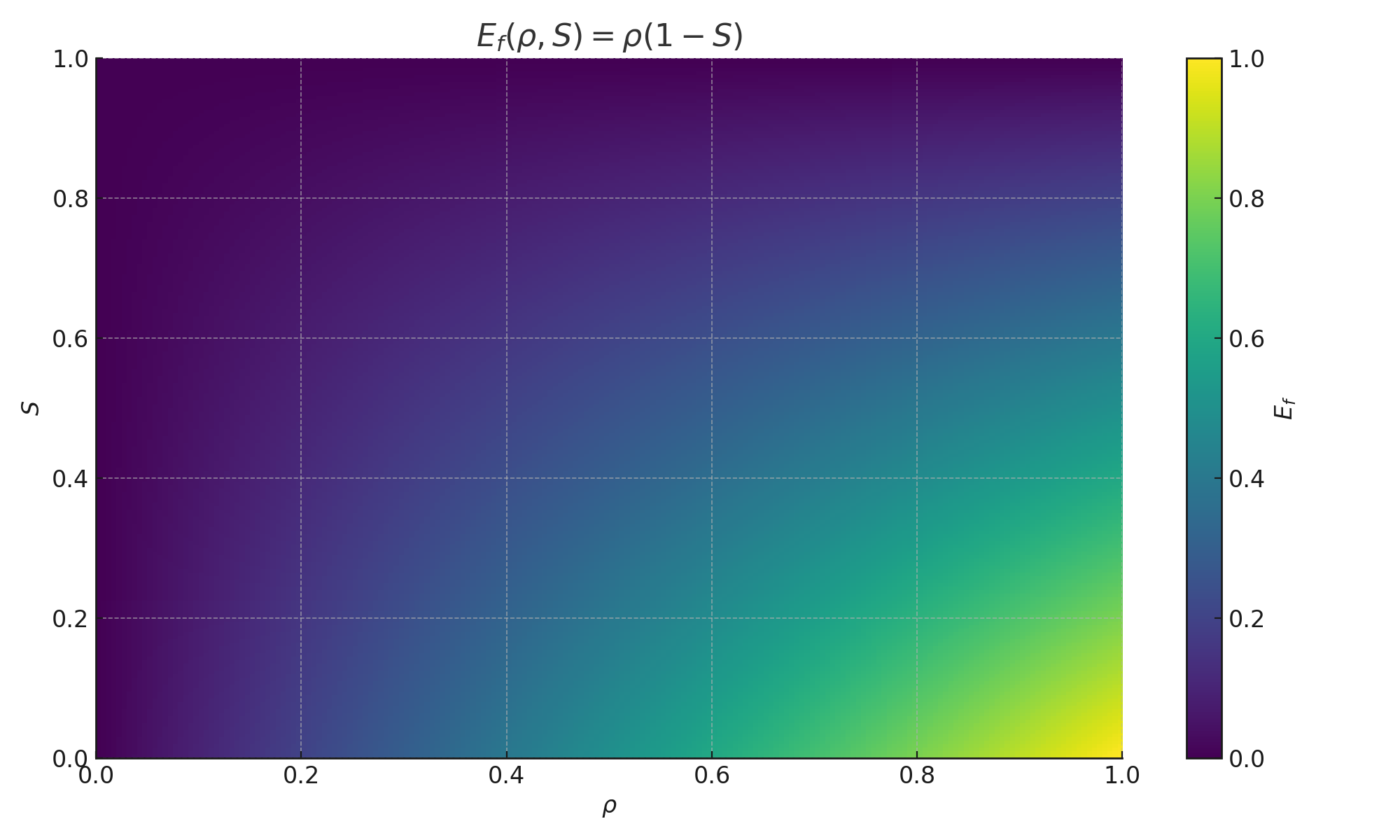
3.1 Energy-flow potential field
Figure 1 shows a schematic map of the energy-flow potential
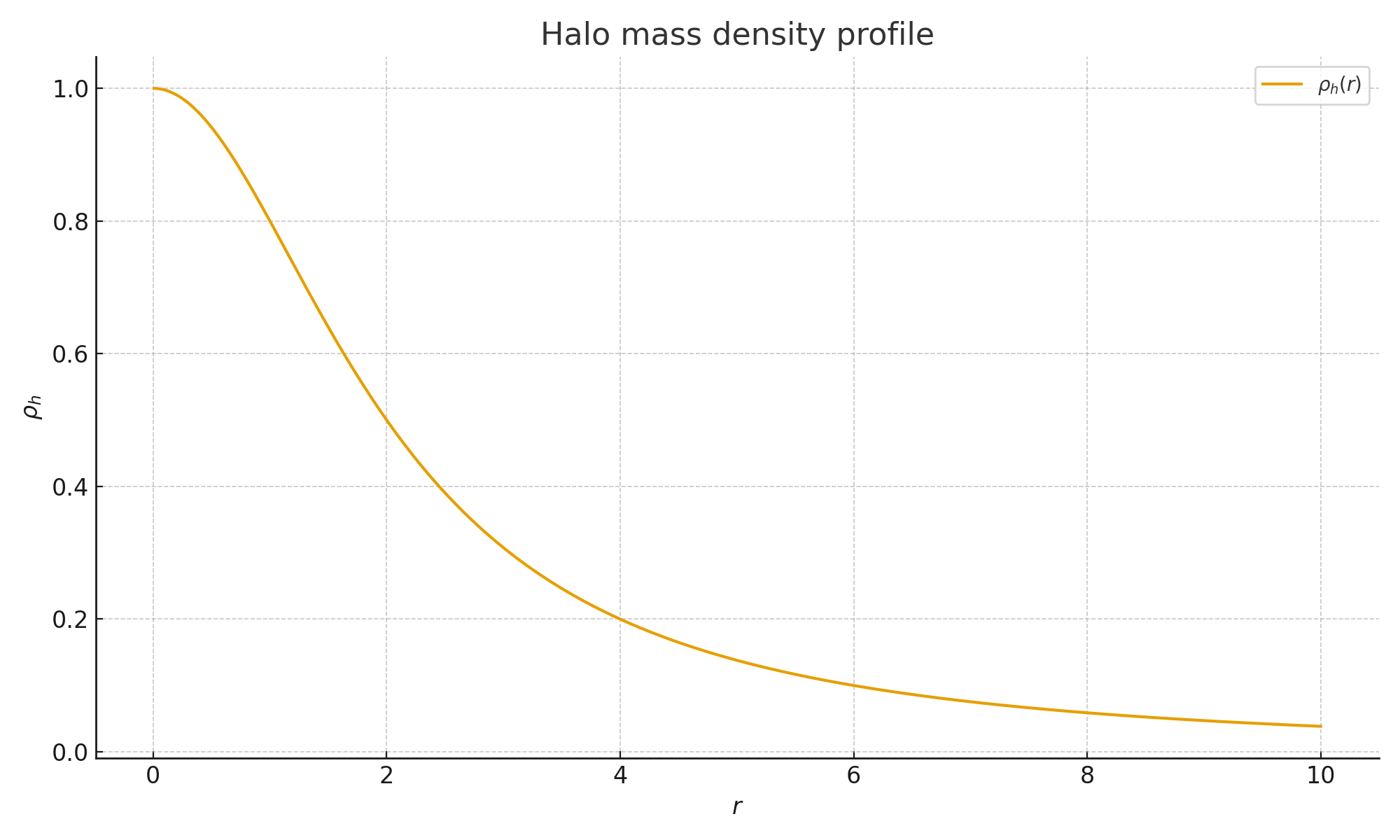
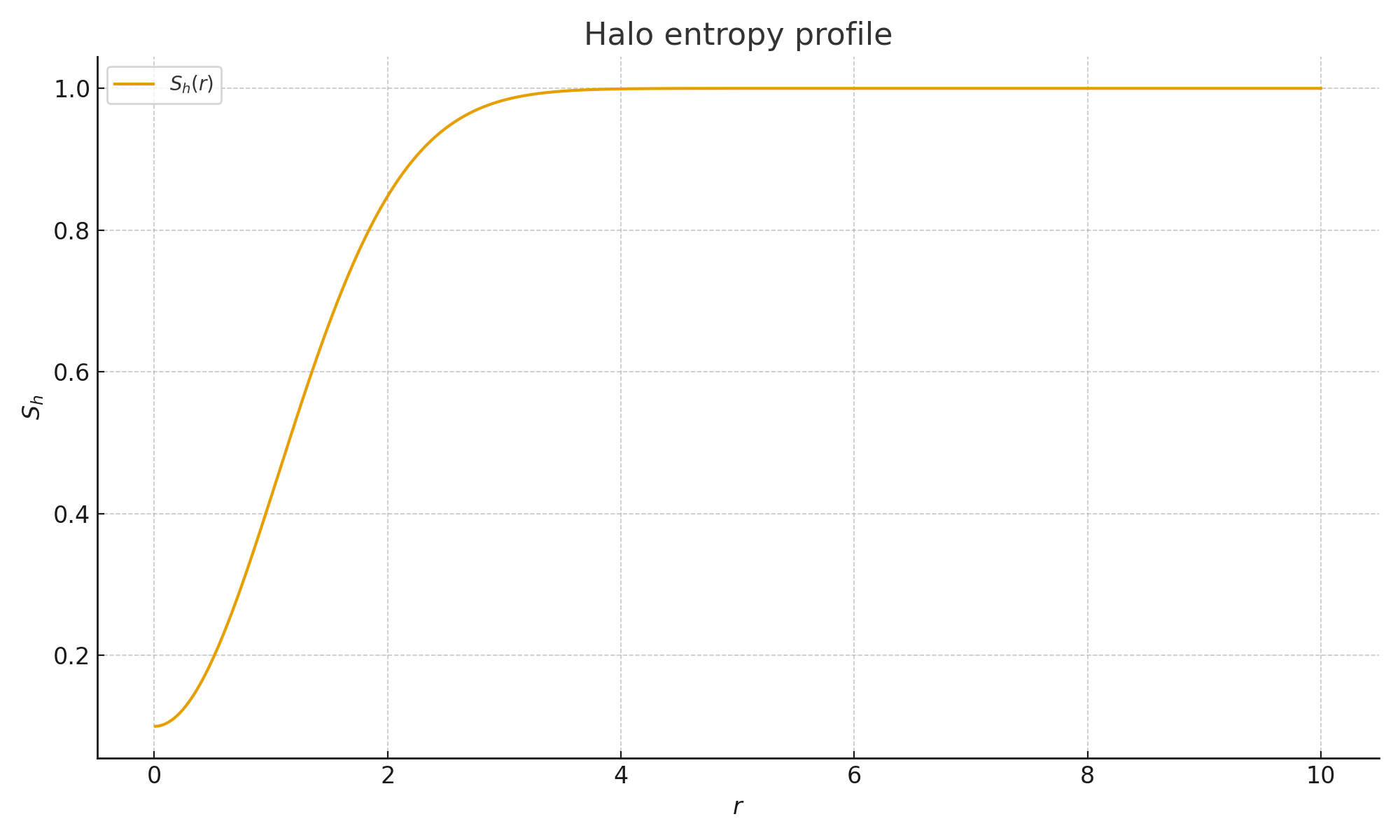
3.2 Halo profiles: mass and entropy
EFC-S models halos as joint profiles in mass density and entropy,
3.3 Rotation curves and projected density
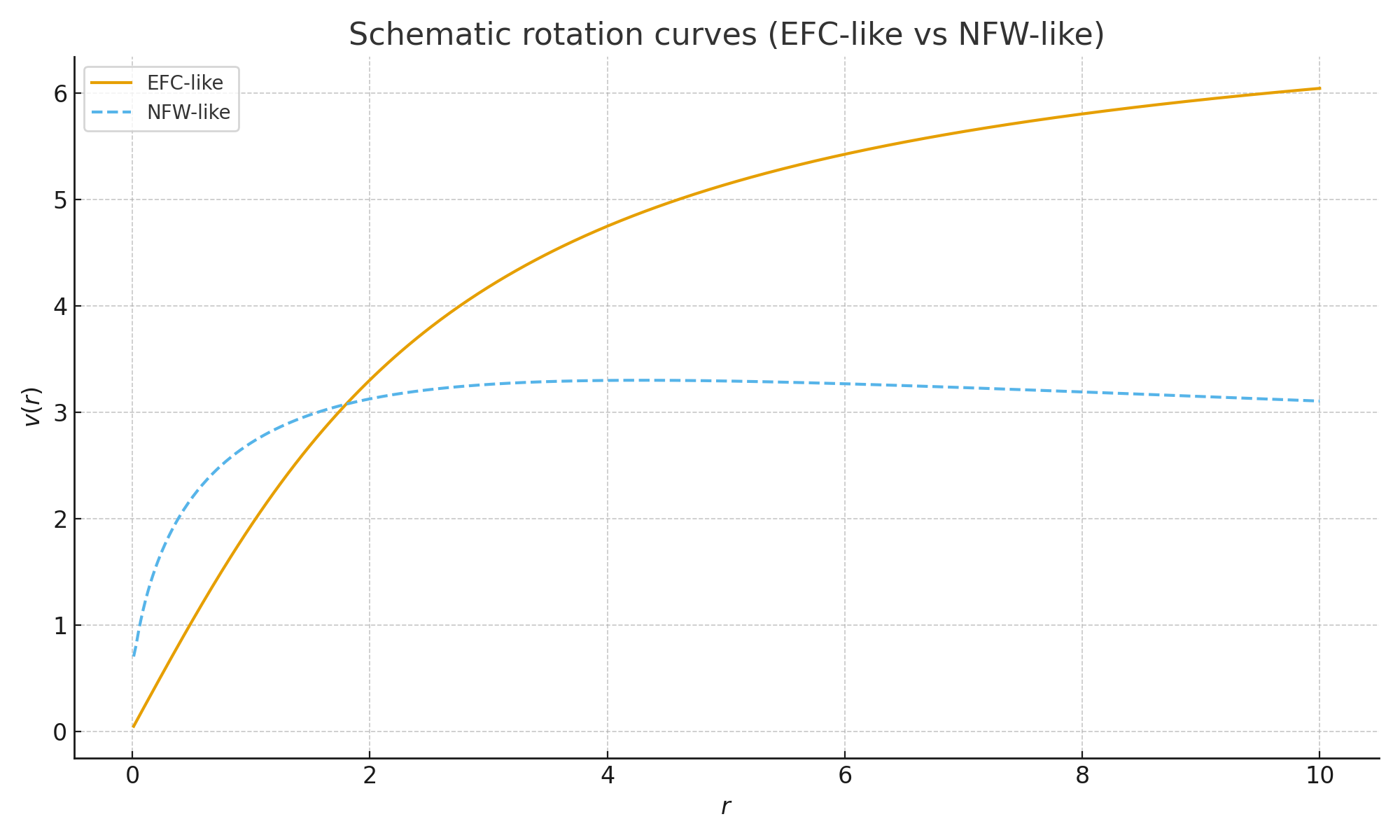
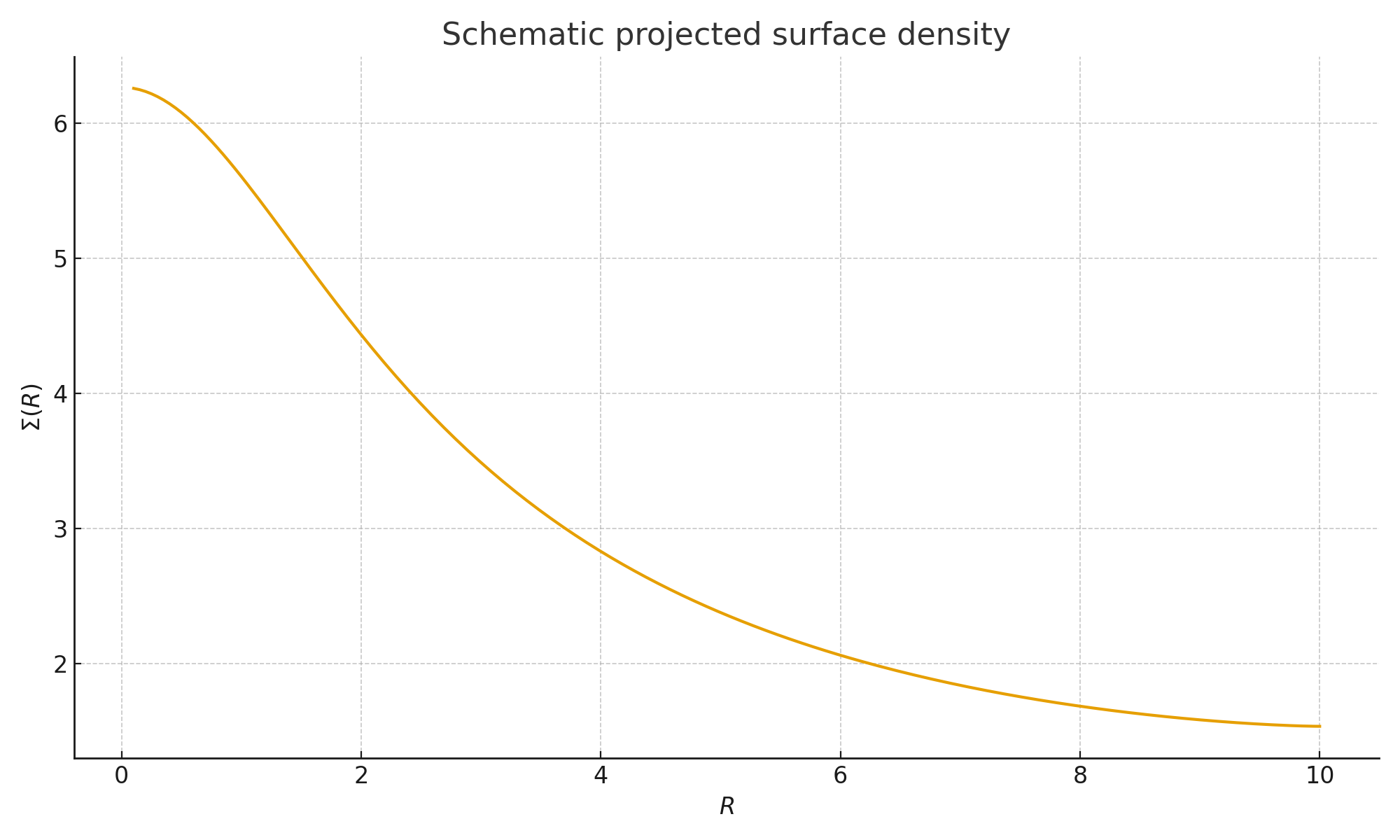
Given a halo profile, EFC-D can be used to derive effective rotation curves and projected surface densities. Figure 4 shows a schematic comparison between an EFC-like rotation curve and an NFW-like reference. Figure 5 shows a corresponding schematic projected surface-density profile.
3.4 Expansion history and information capacity
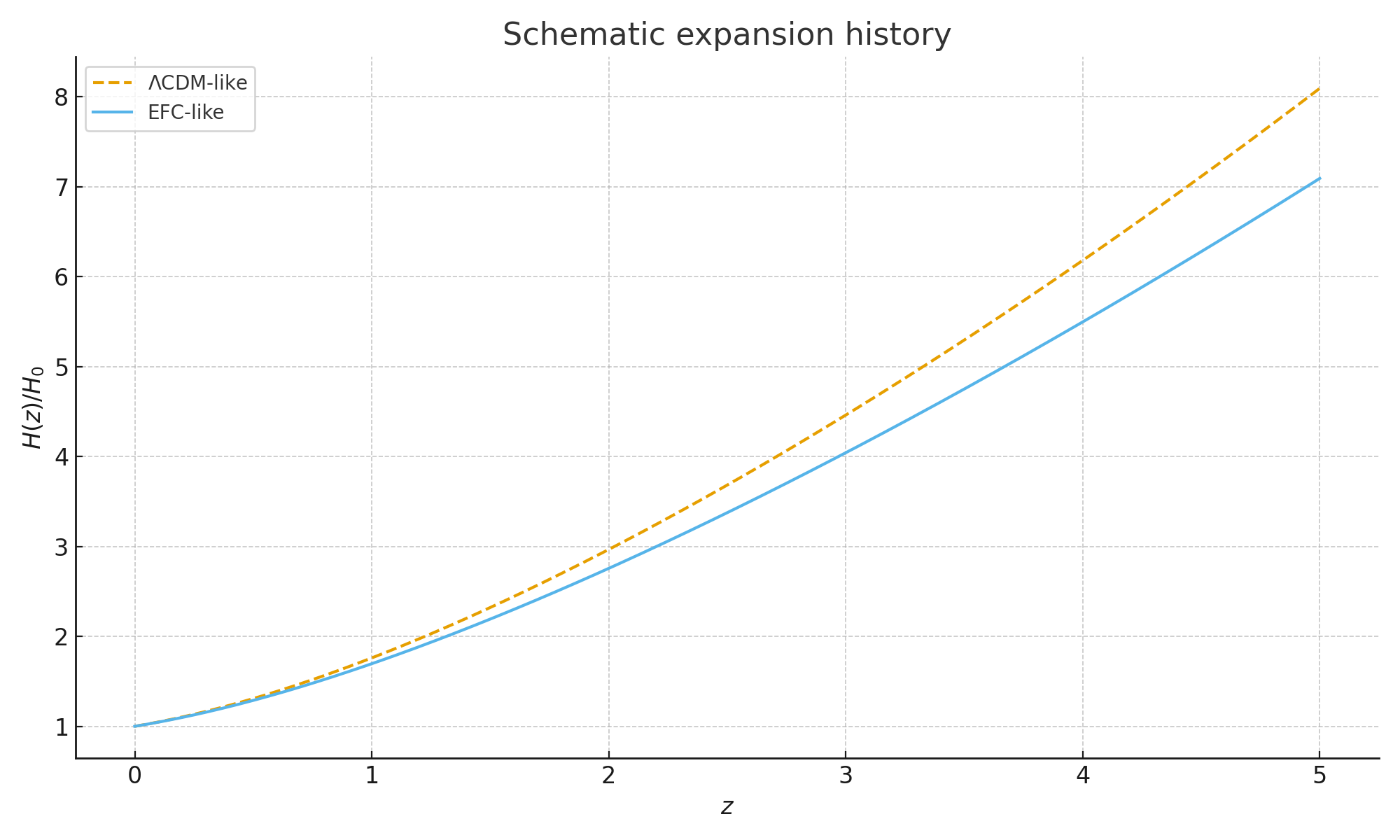
EFC treats the effective expansion rate
4. Part I — EFC-S: Structure / Halo Layer
4.1 S₀. Low-entropy anchors
EFC-S starts from the idea that structure forms around low-entropy anchors. These are local regions where matter and energy are concentrated in configurations that allow sustained energy flows.
Let
where
4.2 S₁. Halo Model of Entropy
In EFC-S, halos are not only mass overdensities, but also entropy-structured regions. A halo profile is described by both mass density and entropy:
where
4.3 S₂. Radial profiles and halo classes
EFC-S allows families of halos parameterised by a small set of structural parameters (for example central density, scale radius and entropy core size). A simple example parametrisation is:
where
5. Part II — EFC-D: Energy-Flow Dynamics
5.1 D₀. Local energy-flow potential
The local energy-flow potential
High density with low entropy yields large
5.2 D₀.2. Mass density
Mass density is defined in the usual way:
where
5.3 D₁. Energy-flow rate and temporal evolution
The temporal change of the energy-flow potential defines an energy-flow rate:
where
Using the definition of
This separates contributions from density change and entropy change: a region can lose energy-flow potential by losing mass, by gaining entropy, or by both.
5.4 D₂. Spatial gradients and effective acceleration
Spatial gradients in
which follows directly from the definition via the product rule.
At the level of an effective description, one can introduce an acceleration field
The minus sign indicates flow towards regions of lower effective potential, in analogy with standard potential theory, but here the potential is thermodynamic–structural rather than purely gravitational.
5.5 D₃. Expansion rate and background behaviour
On large scales, an effective expansion rate
where
6. Part III — EFC-C₀: Entropy–Cognition Base Layer
6.1 C₀. Entropy and information capacity
EFC-C₀ links thermodynamic entropy to potential for information processing. The goal is not a psychological model, but a base mapping between physical structure and abstract information capacity.
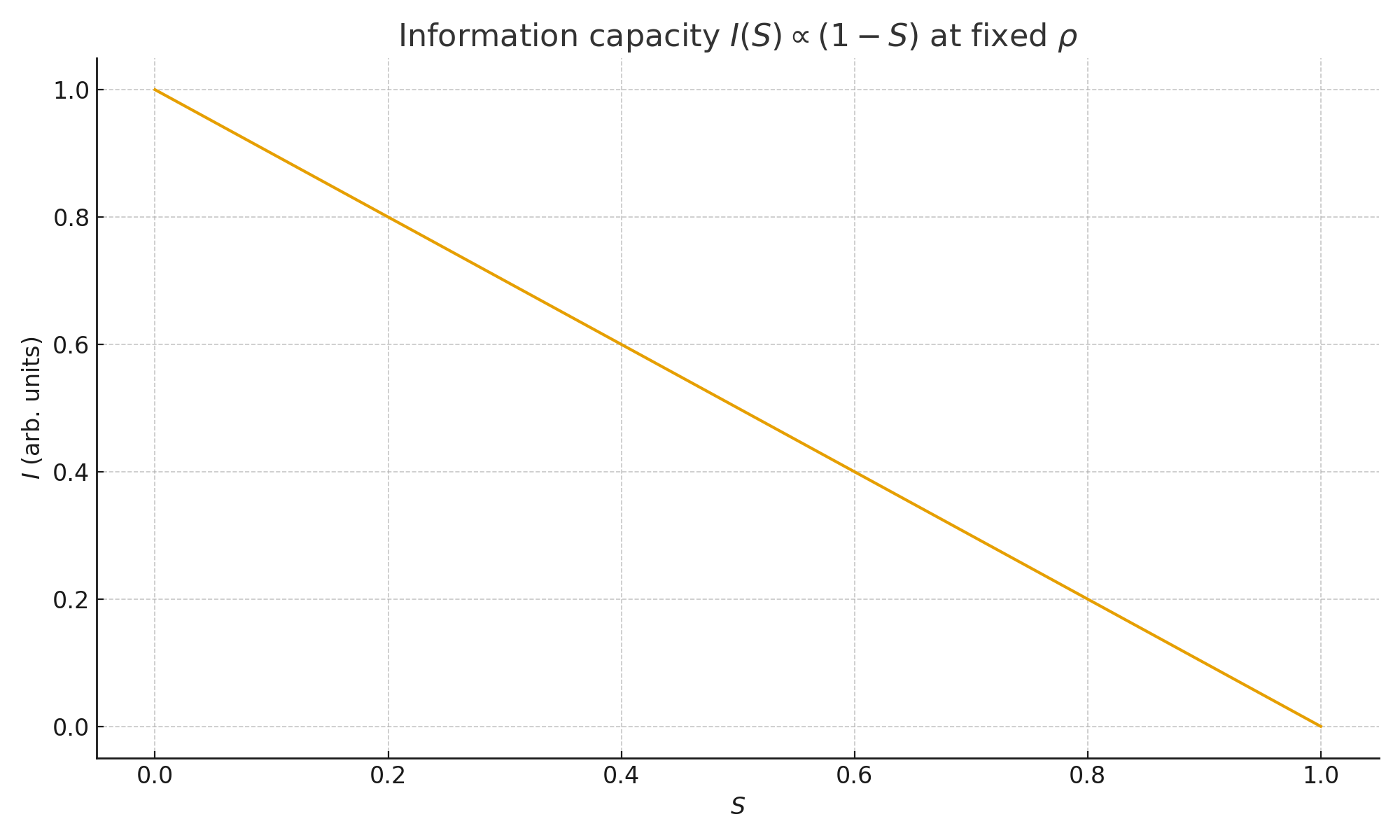
A local information capacity
This mirrors the structure of
6.2 C₁. Local cognitive load
For a coarse-grained region
A simple scalar cognitive-load variable
where
6.3 C₂. Informational field coupling
EFC-C₀ treats information structures as coupled to the same energy-flow fields that drive dynamics
in EFC-D. At a coarse-grained level, one can express this by letting
where:
This is a minimal base equation that later cognitive layers can extend.
7. Appendix: Symbols and Definitions
The table below summarises the main symbols used in this master specification.
| Symbol | Meaning | Notes |
|---|---|---|
| Mass density | ||
| Dimensionless entropy | Normalised to |
|
| Local energy-flow potential | ||
| Time derivative | Along chosen evolution parameter | |
| Halo mass density profile | Part of EFC-S halo model | |
| Halo entropy profile | Part of EFC-S halo model | |
| Local information capacity | Base variable in EFC-C₀ | |
| Cognitive load | ||
| Effective expansion rate | Derived from flow and entropy | |
| Reference expansion scale | To be calibrated against data | |
| Coupling coefficients | Link between |
8. How to Cite
Magnusson, M. (2025). Energy-Flow Cosmology (EFC) — Master Specification v1.1. Figshare. DOI: 10.6084/m9.figshare.30630500 .
DOI:
10.6084/m9.figshare.30630500
Author: M. Magnusson
ORCID:
0009-0002-4860-5095
Licence: CC-BY 4.0 (Creative Commons Attribution 4.0 International).
This HTML representation corresponds to the archived and versioned research object stored on Figshare. Future versions of the theory (EFC v1.x, v2.x) will reference this DOI as the baseline formal specification.
9. References
This master specification can be combined with an external reference list (articles, datasets, code repositories). A fixed bibliography can be embedded in later versions.